In the Special Edition Filipino Martial Arts Digest Issue 2008, under the Publisher’s Desk column, I read this “First this thesis was totally about the Moro-Moro Orabes Heneral style and its Grandmaster Alejandro “Andy” Abrian, however Mara Nepomuceno could see that this art has the possibility and is in danger of extinction, unless an effort is made to preserve this art. So what he has added is an overall concept of what Eskrima is about and some of the means that are necessary to preserve the art. For at this time there are only a very few that are trying to keep the pure form of Moro-Moro Orabes Heneral alive.”1
The phrase “danger of extinction” caught my attention. This system may disappear. Gone. Poof. No longer in existence. Future martial artists would no longer have this system available to them to learn from.
And that made me sad.
And motivated me to search for more information about Grandmaster Abrian and his Moro-Moro Orabes Heneral system.
Alejandro2 “Andy” Abrian, the founder of Moro-Moro Orabes Heneral Arnis, was born in Eastern Samar on either November 3, 19363, or in 1937.4 5 Growing up among the Waray people6—known historically for their fierce blade-fighting culture—he was surrounded from his youth by old-time eskrimadors and real-world duels.7 During this time, the Philippines was swept up in a massive boxing boom, fueled by Cebuano legend Gabriel “Flash” Elorde’s reign as a world boxing champion.8 9 Abrian was drawn to pugilism, often engaging in spontaneous fistfights during local basketball games and community dance parties.10
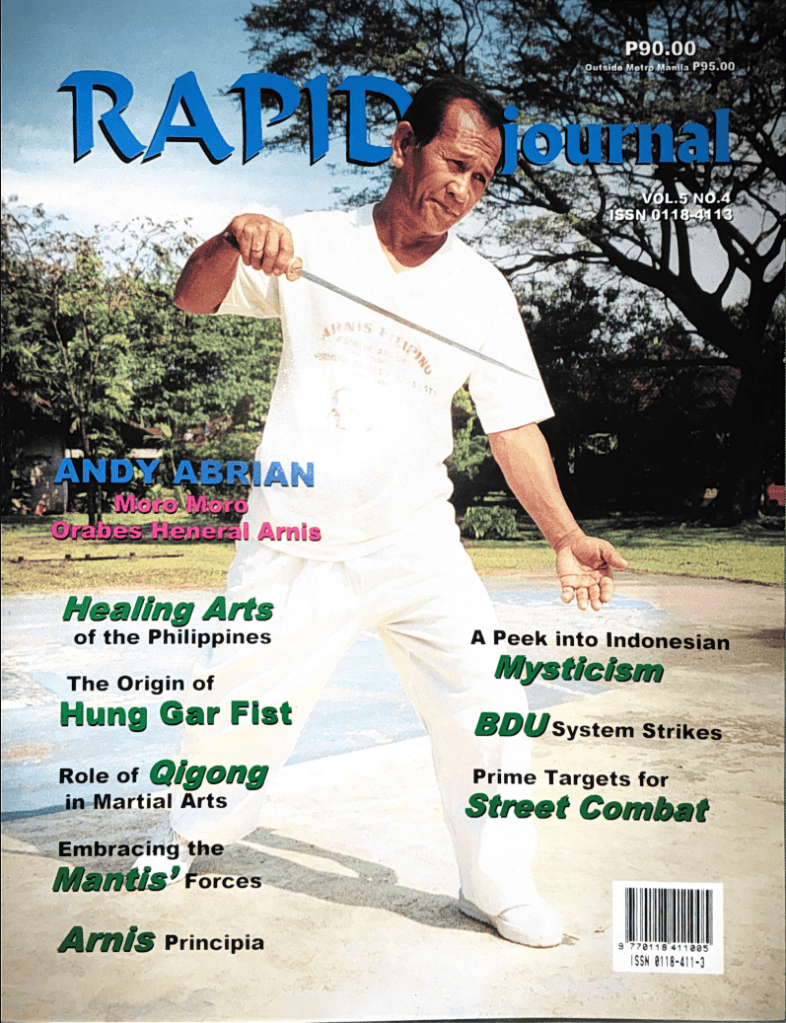
Abrian’s martial arts path started when he set out to challenge Mang Pasi, a wandering boxer and skilled eskrimador from Bohol. After going a few rounds with him, Mang Pasi recognized the Abrian’s quick reflexes and natural agility, but offered a blunt piece of advice: Abrian lacked the power of a knockout puncher and would never excel in the boxing ring. Instead, Pasi advised him to pursue the art of Eskrima, emphasizing that it was a practical combat science he could continue to train, refine, and rely upon well into his golden years. Taking this guidance to heart, Abrian redirected his energy away from boxing and threw himself entirely into the study of the blade.11 12 13. Abrian was seventeen years old.14
Without a formal school or a teacher, Abrian’s initial training was a grueling, self-directed endeavor conducted daily along the seashore of Samar. To build exceptional physical attributes and stamina, he developed a highly demanding, naturalistic endurance regimen: climbing coconut trees, hunting wild animals, and performing weapon and empty-hand drills with the lower half of his body fully immersed in the ocean.15 He also spent years watching and interacting with local elders who were proficient escrimadores, adapting their varied methods into a personal, highly practical combative system.16
In search of a livelihood, Abrian eventually relocated to Manila, where he worked for ten years as a janitor at Manila’s historic Luneta Park.17 It was during this period that he encountered the legendary Kalis Ilustrisimo group training outdoors and began studying under its iconic grandmaster, Antonio “Tatang” Ilustrisimo.18 19
In 1955, synthesizing his childhood training, boxing mechanics, and the insights gathered under Tatang Ilustrisimo, Abrian founded his own system: Moro-Moro Orabes Heneral Arnis. For decades, Abrian kept his art strictly secret, utilizing it solely as a personal system of self-defense.20 21 22
Abrian’s transition to public teaching was almost accidental. In the late 1980s, Abrian was watching Master Yuli Romo, a Filipino Martial Artist, teach students at Luneta Park. Romo recognized Abrian from his interactions with Tatang Ilustrisimo and urged Abrian to share his system. Soon after, Abrian began teaching his unique art publicly in the park.23
In September 2006, Abrian suffered his sixth stroke, which left him confined to a wheelchair with slurred speech and impaired hearing. Even in this compromised state, his mind remained sharp, and his grip remained strong. From his chair, he continued to teach.24 Abrian passed away on April 18, 2010.25
- Alejandro Abrian and Moro-Moro Orabes Heneral, Dowd,Steven K. , Filipino Martial Arts Digest, Special Edition 2008, p. 3. ↩︎
- States Abrian’s first name is Andrew. Moro Moro Orabes Heneral Arnis: An Interview with Arnis Master Andrew Abrian, Dy,Edwin, Rapid Journal, Vol. 5 No. 4, 2001, p. 2. ↩︎
- A Memorial to GM Alejandro “Andy” Abrian (1936 – 2010), James U. Sy Jr., Visayan Filipino Martial Arts blog, June 11, 2010, viewed on August 15, 2026. ↩︎
- Moro-Moro Orabes Heneral by Mark V. Wiley, Filipino Martial Arts Magazine, January 2001, p. 8. ↩︎
- Filipino Fighting Arts: Theory and Practice, Wiley, Mark V., Unique Publications, 2000, p. 221. ↩︎
- “Waray people inhabit most of Samar where they are called Samareños/Samarnons, the northern part of the island of Leyte…and the island of Biliran.” Waray People, Wikipedia, viewed on August 30, 2026. ↩︎
- Alejandro Abrian and Moro-Moro Orabes Heneral, Nepomuceno,Mara, Filipino Martial Arts Digest, Special Edition 2008, p. 5. ↩︎
- Moro Moro Orabes Heneral Arnis: An Interview with Arnis Master Andrew Abrian, Dy,Edwin, Rapid Journal, Vol. 5 No. 4, 2001, p. 2-3. ↩︎
- A Memorial to GM Alejandro “Andy” Abrian (1936 – 2010), James U. Sy Jr., Visayan Filipino Martial Arts blog, June 11, 2010, viewed on August 15, 2026. ↩︎
- Moro Moro Orabes Heneral Arnis: An Interview with Arnis Master Andrew Abrian, Dy,Edwin, Rapid Journal, Vol. 5 No. 4, 2001, p. 2-3. ↩︎
- Moro Moro Orabes Heneral Arnis: An Interview with Arnis Master Andrew Abrian, Dy,Edwin, Rapid Journal, Vol. 5 No. 4, 2001, p. 2-3. ↩︎
- Alejandro Abrian and Moro-Moro Orabes Heneral, Nepomuceno,Mara, Filipino Martial Arts Digest, Special Edition 2008, p. 5. ↩︎
- A Memorial to GM Alejandro “Andy” Abrian (1936 – 2010), James U. Sy Jr., Visayan Filipino Martial Arts blog, June 11, 2010, viewed on August 15, 2026. ↩︎
- Moro Moro Orabes Heneral Arnis: An Interview with Arnis Master Andrew Abrian, Dy,Edwin, Rapid Journal, Vol. 5 No. 4, 2001, p. 2. ↩︎
- Alejandro Abrian and Moro-Moro Orabes Heneral, Nepomuceno,Mara, Filipino Martial Arts Digest, Special Edition 2008, p. 5. ↩︎
- Moro Moro Orabes Heneral Arnis: An Interview with Arnis Master Andrew Abrian, Dy,Edwin, Rapid Journal, Vol. 5 No. 4, 2001, p. 3. ↩︎
- “Rizal Park, Luneta, also known as Rizal Park, Luneta Park, or simply Luneta,is a historic urban park located in Ermita, Manila, Philippines.” Rizal Park, Wikipedia, viewed on August 30, 2026. Many Filipino Martial Artists routinely train at Luneta Park. ↩︎
- Alejandro Abrian and Moro-Moro Orabes Heneral, Nepomuceno,Mara, Filipino Martial Arts Digest, Special Edition 2008, p. 6. ↩︎
- A Memorial to GM Alejandro “Andy” Abrian (1936 – 2010), James U. Sy Jr., Visayan Filipino Martial Arts blog, June 11, 2010, viewed on August 15, 2026. ↩︎
- Alejandro Abrian and Moro-Moro Orabes Heneral, Nepomuceno,Mara, Filipino Martial Arts Digest, Special Edition 2008, p. 6. ↩︎
- Moro Moro Orabes Heneral Arnis: An Interview with Arnis Master Andrew Abrian, Dy,Edwin, Rapid Journal, Vol. 5 No. 4, 2001, p. 2.
↩︎ - A Memorial to GM Alejandro “Andy” Abrian (1936 – 2010), James U. Sy Jr., Visayan Filipino Martial Arts blog, June 11, 2010, viewed on August 15, 2026. ↩︎
- Moro Moro Orabes Heneral Arnis: An Interview with Arnis Master Andrew Abrian, Dy,Edwin, Rapid Journal, Vol. 5 No. 4, 2001, p. 5. ↩︎
- Alejandro Abrian and Moro-Moro Orabes Heneral, Nepomuceno,Mara, Filipino Martial Arts Digest, Special Edition 2008, p. 17. ↩︎
- A Memorial to GM Alejandro “Andy” Abrian (1936 – 2010), James U. Sy Jr., Visayan Filipino Martial Arts blog, June 11, 2010, viewed on August 15, 2026. ↩︎
 FMA Chronicles
Leave a comment