“Butterfly knives made before World War II were crude compared to the impeccably honed bladed weapons of Japan and China.”1 Early balisongs were designed for practical use in the humid Philippine climate, for example, to slash through light garments.2 Some “..balisongs [were]…designed for one-time use only. After penetrating the adversary’s body, the balisong is jerked in such a way as to attempt to break the pins at the tang to leave the blade embedded in the body. Hence, it will be used only once.”3
Today, Philippine made balisongs have evolved into prized artistic possessions.
The craftsmanship of the Filipino panday (blacksmith) is remarkable because they produced complex designs using relatively crude equipment. “The Batanguenos…are noted to produce Balisong knives from the junked spare parts of jeeps and trucks left over from the Second World War.“4. Traditionally, balisongs were made from a variety of reclaimed materials.
The design of a balisong is unique because it “is constructed of two handles that receive the blade. Each handle is attached to the blade by a pin. A third pin at the base of the blade serves to stop and limit the rotation of the handles and/or the blade to 180 degrees. When not in use, the handles are folded over the blade, thereby forming a sort of enclosure or sheath.”5 6
The parts of a balisong are:
- The Pins: Each handle is attached to the blade by a pivot pin. A third pin, the tang pin, limits the rotation and keeps the handles in place when open.
- The Handles: The durability and feel of a balisong depend heavily on its handle design. There are three primary methods of construction:
- Open Edged: Originally intended to repurpose spare parts, these “see-through” handles use a dual tang pin system to stop the blade. They are the easiest to maintain and clean, making them ideal for hunters or field use.
- Sandwiched: This is the classic Filipino design. These handles are built in layers, with bolsters and handle scales pinned or screwed to a slotted brass lining.
- Solid: These are the most robust handles available. While entry-level versions are often die-cast, premium models are milled from a single bar of solid metal for maximum strength.7
Early handles were often carved from animal horns, such as deer or carabao (water buffalo).8 9 These were preferred for providing a lighter and better grip.10 Today, handles may also feature mother-of-pearl, ivory, or rare woods.11. “Ammo shells and brass munitions casings provided butt or pummel mountings that secured the end sections of the handles.”12
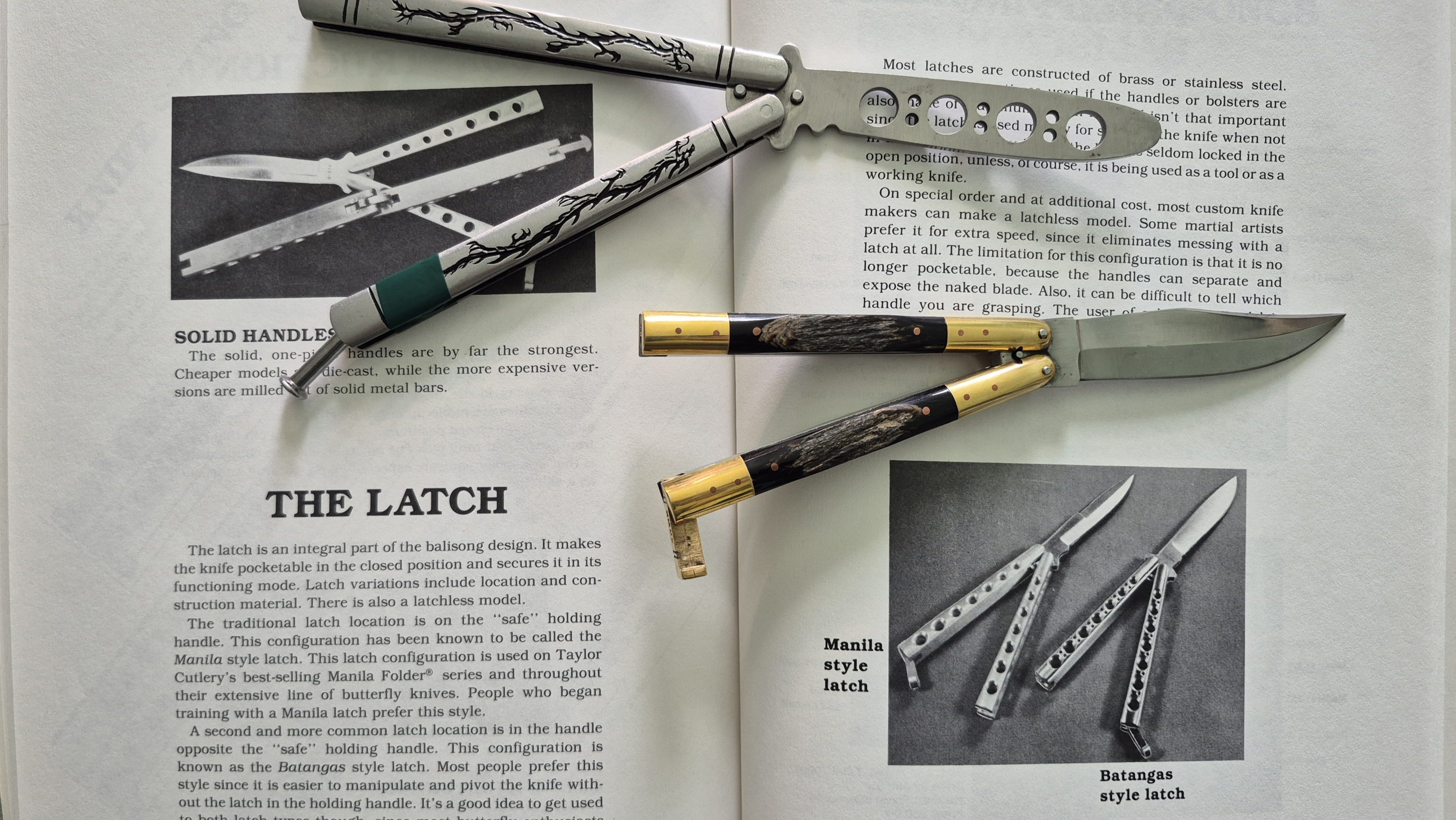
- The Latch: This is the mechanism that secures the handles together. The latch is a defining feature of the balisong, ensuring both safe concealment and functional stability. While variations exist in material and placement, a firm, properly sized latch is essential for performance; a loose or poorly fitted latch can damage the blade and disrupt flipping mechanics. Practitioners often prefer a slightly extended latch tip to facilitate a quick, reliable opening, balancing the knife’s role as a secure pocket tool with its utility as a fast-deploying weapon. For example, “the Visayan knife fighter usually prefers a latch with a tip that extends about one-eighth to one-quarter inch beyond the side of the handle. This permits him enough room to pop the latch quickly and easily when he needs to. Latches that are too short can make flipping the knife open difficult, and longer latches can hinder drawing the knife.”13 14 15 16 There are two primary styles:
- The Blade: The “blade could be a simple one, could be serrated and could be of Damascus blade material. The balisong’s blade could be made in the form of a kris. A balisong with a kris blade is a very popular and also a very expensive one.”19 Balisongs are made with various sharp points:
- Drop Point – an all-rounder design
- Clipped Point – the clip narrows the tip; providing a piercing capability.
- Double Edged – both sides are sharpened.20
Historically, blades were forged from discarded suspension springs (leaf springs) from abandoned U.S. Army jeeps and trucks.21 This scrap metal provided high-quality, sturdy steel that could maintain an incredibly sharp edge.22
Making the balisong requires many steps. First, the liner (magtatalag) which is the housing of the balisong is made. The panday makes the blade. Lastly, the panday then combines the housing and the blade to complete the balisong.23
The journey of the butterfly knife is one of constant adaptation. From the specific length of a Visayan latch to the pivot of a tang pin, every millimeter of the balisong is intentional. It is an example of a design that has reached near-perfection: a tool that is its own sheath, a weapon that is its own art piece, and a historical artifact that remains as functional today as it was a century ago.
- Balisong: The Lethal Art of FIlipino Knife Fighting, by Sid Campbell, Gary Cagaanan, Sonny Umpad, Paladin Press, 1986, p. 9 ↩︎
- Balisong: The Lethal Art of Filipino Knife Fighting, by Sid Campbell, Gary Cagaanan, Sonny Umpad, Paladin Press, 1986, p. 9 ↩︎
- Pananandata: History and Techniques of the Daga, Yantok, Balisong, and Other Traditional Weapons of the Philippines, Marinas Sr., Amante, Paladin Press, 2002, p. 12, 20. ↩︎
- Vientenueve Balisong: Filipino Knife Fighting, by Shishir Inocalla, p. 11. ↩︎
- The Pananandata Balisong article by Prof. Amante P. Mariñas Sr., Tambuli Journal 20th Anniversary Edition, edited by Mark Wiley, 2013. ↩︎
- Pananandata: Guide to Balisong Openings, Amante P. Mariñas Sr. and Amante P. Mariñas Jr., Unique Publications, 2007, p. 13 ↩︎
- The Advanced Balisong Manual, Imada, Jeff, Unique Publications, 1986, p 93-94. ↩︎
- The Balisong Manual, by Jeff Imada, Know Now Publishing Company, 1984, p. 8 ↩︎
- Arnis: Presas Style and Balisong, by Grandmaster Ernesto A. Presas, Ernesto A. Presas, 1988, p. 175 ↩︎
- Vientenueve Balisong: Filipino Knife Fighting, by Shishir Inocalla, p. 11. ↩︎
- Filipino Martial Culture, by Mark Wiley, Tuttle Publishing, 1997, p. 123 ↩︎
- Balisong: The Lethal Art of FIlipino Knife Fighting, by Sid Campbell, Gary Cagaanan, Sonny Umpad, Paladin Press, 1986, p. 3, 9 ↩︎
- Balisong: The Lethal Art of Filipino Knife Fighting, Campbell, Sid; Cagaanan, Gary; and Umpad, Sonny, Paladin Press, 1986, p. 12. ↩︎
- The Advanced Balisong Manual, Imada, Jeff, Unique Publications, 1986, p 94. ↩︎
- Latiko and Balisong: The Odd Couple, by Marinas, Amante “Mat” P., Exotic Martial Arts of Southeast Asia, September 1997, p. 80 ↩︎
- Pananandata: The Guide to Balisong Openings, Unique Publications, 2007, p. 13-14. ↩︎
- The Advanced Balisong Manual, Imada, Jeff, Unique Publications, 1986, p 94. ↩︎
- The Advanced Balisong Manual, Imada, Jeff, Unique Publications, 1986, p 94. ↩︎
- Latiko and Balisong: The Odd Couple, by Marinas, Amante “Mat” P., Exotic Martial Arts of Southeast Asia, September 1997, p. 80 ↩︎
- Illustrative Field Guide to Filipino Blades, by Blue Stargazer, Blue Stargazer, 2025, ebook. ↩︎
- Filipino Martial Culture, by Mark Wiley, Tuttle Publishing, 1997, p. 123 ↩︎
- Balisong: The Lethal Art of FIlipino Knife Fighting, by Sid Campbell, Gary Cagaanan, Sonny Umpad, Paladin Press, 1986, p. 3 ↩︎
- The blade that defines the Batangueno, by Mei Magsino, VERA Files, Nov 17, 2011. ↩︎
Article updated April 22, 2026.
 FMA Chronicles
Leave a reply to Balisong, The Filipino Butterfly Knife – FMA Chronicles Cancel reply