“If a tiger dies, he leaves his skin; if a man dies he leaves his name.” – Ernesto Presas1
When asked what drove Grandmaster Ernesto Presas to teach Filipino Martial Arts and what are the rewards of his teaching, he said “I wanted to share and make known the ‘art; of the Philippines and that of my father, and to the world – the modern arnis style I had improved and developed. I wanted to show people of the world that arnis is equal to the very ancient art ‘kali,’ but also that modern arnis is a martial art for today. It is a martial art that deserves worldwide recognition.”2
Ernesto dedicated his life to achieve his dream. He learned classic arnis from his father Jose Presas who was a master of the art. He trained with his brothers Remy and Roberto. He was invited to demonstrate arnis, including outside of the Philippines. He taught arnis to others, including at universities and around the world.
Ernesto saw that “arnis was dying from a lack of native patronage. Centuries of Western colonialism had directed the Philippine people more and more toward Occidental athletic sports. Our cultural heritage and traditional martial art forms were dying…Through the promotional efforts of the International Philippine Martial Arts Federation (IPMAF), [which was started by Ernesto in 1975,] arnis is being recognized on a level equal with the best mainstream martial arts systems. I want to help arnis become rediscovered.”3
By the 1990s, Ernesto said, “Modern arnis is gaining the attention of the martial arts world and being called the ‘new’ art. This decade will bring international recognition to modern Philippine arnis…as more and more people discover the versatility and challenge of this sport. This is happening now in the United States. Modern arnis is facing both cultural revival and discovery with worldwide acceptance.”4
To achieve this acceptance, Ernesto taught his art throughout the world including Australia. Canada, Denmark, Dominican Republic, Germany, Haiti, Iran, Jamaica, Japan, Mexico, New Zealand, Norway, Puerto Rico, Saudi Arabia, South Africa, Sweden, and the United States.5 6 7 8
In 1991, Ernesto “was invited in Germany at a ‘Budo Gala’ demonstration, a gathering of respected and acclaimed martial artists from the different parts of the world. ‘Mano-Mano’ won the admiration of many due to the unique combative Filipino empty hand technique introduced by Grandmaster Ernesto Presas.”9
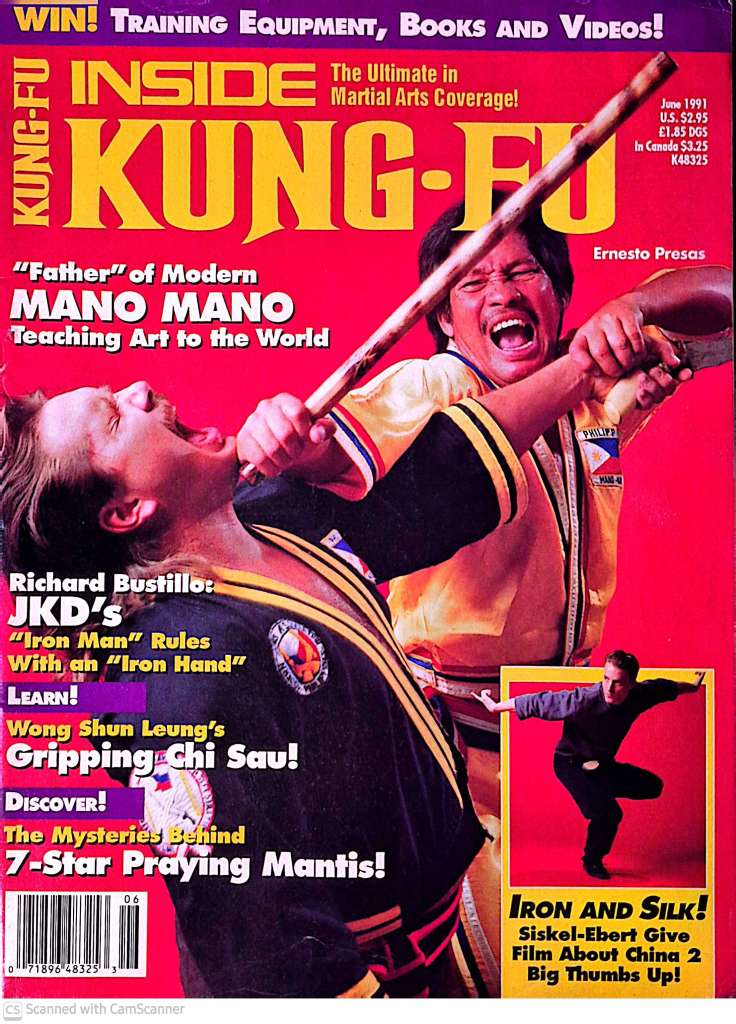
He has also published numerous books and videos and has been featured on the cover of Inside Kung Fu magazine with the title “Ernesto Presas: The Father of Mano-Mano” (which art he created).10
Ernesto published the following books:
- The Art of Arnis: A Modern Presentation of an Ancient Martial Art, 1979.
- Arnis Presas Style and Balisong, 1988.
- Filipino Modern Mano-Mano Presas Style, 1996.
- Filipino Armas de Mano Presas Style, 1996.
- Filipino Police Combative Technique, 1996.
- Filipino Knife Fighting Presas Style, 1998.
- Dumog Presas Style, 2002.

He also produced videos and was interviewed for many articles. Some magazines that published stories about him included: Inside Kung Fu, Filipino Martial Arts, Martial Arts Combat & Sports, and Close Quarter Combat.
Ernesto “was given the Grandmasters’ Award by the Hall of Fame in September 6, 1996 held in Jacksonville, Florida, USA.”11
“In the year 2000, 2nd of September, Grandmaster Ernesto A. Presas was inducted and conferred the ‘Millennium Leadership’ by the World Head of Sokeskys Council International Hall of Fame in Orlando, Florida, USA.” “The same organization also conferred to Grandmaster Presas the ‘International Grandmaster Instructor of the Year’ last September 1, 2001.”12 13
Throughout many of Grandmaster Ernesto’s books, he has a quote in the dedication “If a tiger dies, he leaves his skin; if a man dies he leaves his name.” When asked how this quote reflects on him. He said “When I die, my art, my name, and my legacy will be left behind. Arnis almost became extinct, endangered like the tiger, before my brother and I began to spread the art. I want the practice of modern Philippine arnis to be carried on and for my teachings and techniques to make sure this will happen.”14
Here’s a 2005 YouTube video of an interview with Grandmaster Ernesto Presas – Great GrandMaster Ernesto A Presas, Kombatan Arnis Philippines Camp Hinigaran, Negros Presas Beach Resort May 2005.
- Grandmaster Ernesto Presas: Teaching his Children Well, by J. Bruce Daniels, Inside Kung-Fu Magazine, June 1991 ↩︎
- Grandmaster Ernesto Presas: Teaching his Children Well, by J. Bruce Daniels, Inside Kung-Fu Magazine, June 1991. ↩︎
- Grandmaster Ernesto Presas: Teaching his Children Well, by J. Bruce Daniels, Inside Kung-Fu Magazine, June 1991. ↩︎
- Grandmaster Ernesto Presas: Teaching his Children Well, by J. Bruce Daniels, Inside Kung-Fu Magazine, June 1991. ↩︎
- Grandmaster Ernesto Presas: Teaching his Children Well, by J. Bruce Daniels, Inside Kung-Fu Magazine, June 1991. ↩︎
- Arnis Presas Style and Balisong, Grandmaster Ernesto A. Presas, 1988. ↩︎
- Grandmaster Ernesto Presas, Kombatan (1945 – 2010), FMA Pulse, June 22, 2013. https://fmapulse.com/fma-legends/grandmaster-ernesto-presas-1945-2010/ ↩︎
- The Presas Family, Filipino Martial Arts Magazine, Jan/Feb 1998. ↩︎
- Dumog Presas Style, Grandmaster Ernesto Amador Presas, 2002. ↩︎
- Grandmaster Ernesto Presas, Kombatan (1945 – 2010), FMA Pulse, June 22, 2013, https://fmapulse.com/fma-legends/grandmaster-ernesto-presas-1945-2010/ ↩︎
- Dumog Presas Style, Grandmaster Ernesto Amador Presas, 2002. ↩︎
- Dumog Presas Style, Grandmaster Ernesto Amador Presas, 2002. ↩︎
- The Most Elite and Prestigious Grandmasters Council in the World website. ↩︎
- Grandmaster Ernesto Presas: Teaching his Children Well, by J. Bruce Daniels, Inside Kung-Fu Magazine, June 1991. ↩︎
 FMA Chronicles
Leave a reply to A Family of Arnis Warriors: 4 Generations of Presas Filipino Martial Artists – FMA Chronicles Cancel reply