We don’t know who created the first balisong. Maybe the person who invented the idea of the balisong was a person who experienced a deep need for a one-handed tool and commissioned a panday (a blacksmith/metal worker) to create the balisong. Or maybe it was a panday who invented and created the balisong.
What is currently known is that “The pandays [blacksmiths] of Batangas clustered around Taal volcano. Among them were those who made the Philippines’ famous balisong. They were fine blacksmiths, considering the complexity of the design of the balisong and the crude equipment they used. To this day, the town of Taal remains a center of the real making of the Philippine balisong.”1 2 “Taal was especially well known for its fine and also commercial quality embroidery and for production of the balisong (similar to a switchblade knife). Many Taaleños were also in the marketing of cottage industry products as travelling merchants.”3
“The Philippines is in the Pacific Ring of Fire, areas where any volcano might just blow its top anytime. Taal Volcano in the province of Batangas had blown its top a number of destructive times causing hundreds of lost lives. When not blowing its top, lava flows out of the volcano. Hence, there is always a fire burning during these times. Not surprisingly, blacksmiths tended to cluster around Taal volcano. Taal, in Batangas, is considered to be the birthplace [sic] of the balisong.”4
Before the balisong industry became popular in the 1940s, Batangas blacksmiths had a market for “artistic bolos (a large knife) with beautiful handles and shaped blades…These bolos were even exhibited in the Manila carnivals and the makers were awarded diplomas.”5
Perfecto De Leon
The balisong was “first constructed in 1905 in [Barrio Balisong], Batangas, Philippines by Perfecto de Leon.6
De Leon “was forced to craft [the balisong] because of a failing bolo manufacturing business.”7 He “happened to buy a big case made of bronze. He could not utilize this bronze in making bolos, so he thought of other means to make use of it. Fortunately, he happened to think of making a knife. After several trials, he was able to finish one which was crude at first as compared with present knives. When others sought the finished product, they bought a piece of metal and tried to make their own.”8 And the balisong industry was born, slowly replacing the bolo industry.
The balisong industry ceased during the Japanese occupation of the Philippines during World War II because it was prohibited by the Japanese and the lack of material.9 “The balisong gained mass exposure after World War II when the Batangueño blade smiths earned a living providing custom crafted knives to American servicemen stationed in the Philippines at Clark Air Force Base and Subic Naval Base.¨10
“With the passing of time, the balisong became increasingly popular until it would ultimately be among the Batagueño’s most recognizable symbols. Its manufacture spread from the barrio of Balisong to the neighboring barrios of Pook, Buli and Tulo.”11
Diosdado Ona
Born November 8, 1950, Diosdado “Mang Dado” Ona was considered to be the balisong “culture keeper.”12 Ona made high-quality balisongs and customers from around the world would visit his Ona Blades store in Taal, Batangas.13 “In front of Ona’s store along the highway of Barangay Balisong is a six-foot balisong.” 14 40% of his customers were foreigners; some balisongs have been sold to customers from Europe, United States, Australia, and Asia.15
Ona was concerned that the craft of balisong making was going to be lost as less young people were learning the craft. “I think if the government would support the balisong industry, and promote it by putting up the fan knife landmarks in all the entrances to the province such as Laguna, Cavite, and Quezon, people will know and appreciate the industry.”16 He was doing his best to keep the industry afloat by producing well-made balisongs that customers would appreciate and collect.17
Why was Ona such an advocate for this knife? “Balisong is not only my passion, it is also a fascination. In 1970, this fan knife saved my life from an attacker who retreated after he saw how fast I was with my balisong, and realized that his small weapon was no match for my bigger fan knife.”18
In 1999, after returning home from his “19-year stint as an Overseas Filipino Worker (OFW) in Saudi Arabia and Taiwan” Ona started his balisong business “to continue the art, culture and craft”.19
Ona has “his grandfather’s over 100-year-old-balisong in his store as remembrance of the [once] flourishing industry of the past.”20
On November 15, 2022, Ona passed away at the age of 72.
“Ang balisong dapat may kaluluwa.” – Diosdado Ona21
The balisong should have a soul.
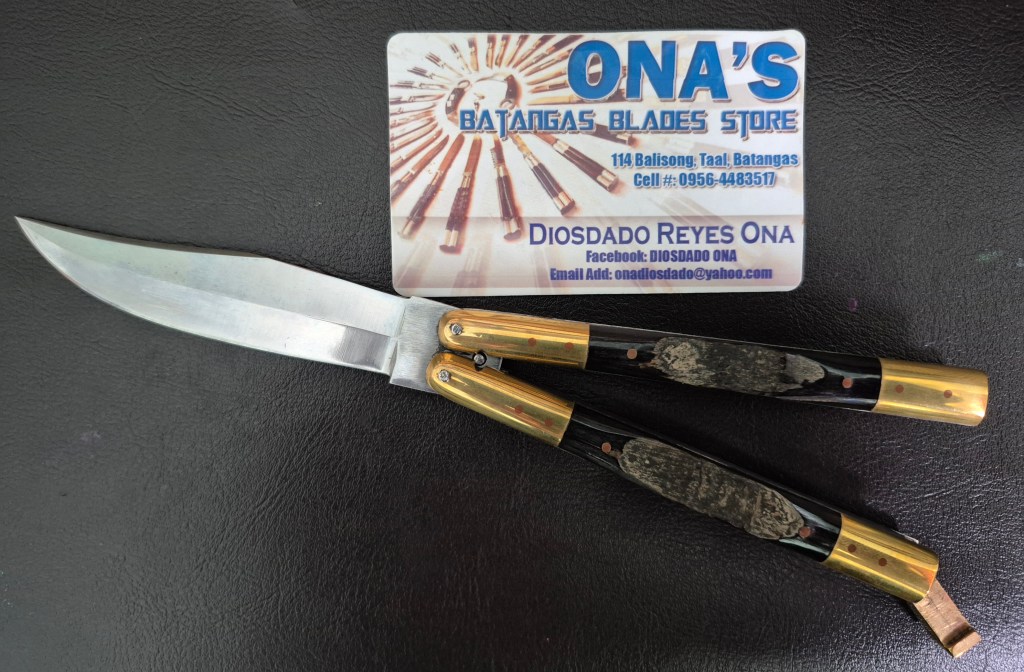
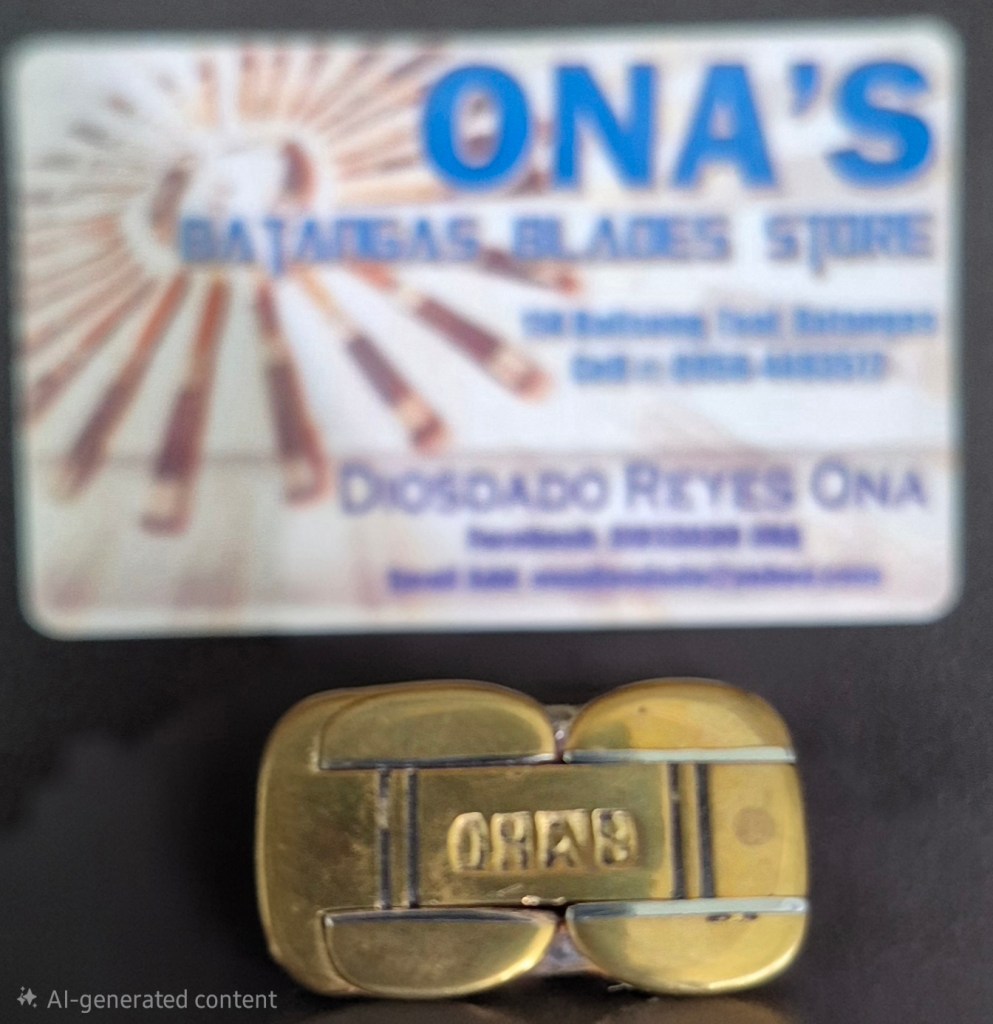
I’m thankful to my friend who gifted me with this balisong from Diosdado Ona in 2021.
YouTube Videos/Website Interviews with Ona.
- The Art of Making Balisong – A Multimedia Thesis, Bryan Villanueva, May 5, 2014.
- The Art of Making Balisong (English Subtitles), Sabrina Bartolome, YouTube, Jan 4, 2016.
- Balisong | Documentary Film, Alexis Marasigan, YouTube, April 21, 2019.
- Hunting the Balisongs and Scouting the Heritage Town of Taal Batangas, Dayo Sa Taal website, June 23, 2022
- Ona’s Balisong, Immersion in Taal website.
Teddy Agojo
Teddy “Mang Teddy” Agojo, born April 1, 1960, was a balisong maker who worked closely with Ona. He passed away shortly after Ona on November 26 2022 at the age of 62.22
“In the early 1970s, Agojo embarked on his journey of creating balisongs. His meticulous attention to detail and use of top-quality materials quickly earned him a reputation. The balisongs he crafted were not only exquisitely finished but also highly functional, captivating collectors and enthusiasts worldwide.”23
The Bautista Brothers of Taal
The Bautista Brothers (Vic, Poyeng and May) are well-known balisong makers in Taal, Batangas. “There family has been making balisongs for generations. They have also worked with Ona and their brother-in-law Agojo.24
YouTube Videos with Bautista Brothers
- Bente Nueve: The Craft of Balisong | Explore Philippines, Explore Philippines, YouTube, Oct 19, 2018.
- Florencio “Poying” Bautista from Bautista Brothers: Balisong Maker of Taal Batangas, Pilipinas kong mahal, YouTube, Feb 24, 2023.
- Pambihirang Binaston na Balisong Gumawa si Poying Bautista, Pilipinas kong mahal, YouTube, Jul 28, 2024. Tidbit about hiding the balisong in a bottle.
These pandays proved that true mastery isn’t defined by the sophistication of the tools or the material, but by the skill of the hands.
YouTube Videos of Pandays making balisongs.
Videos in Tagalog.
- Legendary BALISONG Master for 35 YEARS sa Taal, Batangas! Alamin natin Ang KWENTO ni TATAY BERT!, Zacas TV, YouTube, Jun 28, 2023. No English subtitles; some English words. Can watch the manufacturing process.
- The ART of Making the BALISONG BATANGAS, Balisong Batangas Group, YouTube, Sept 30, 2023. Minimal English subtitles. Can watch the manufacturing process.
- The Art of Balisong, PhilTrip, YouTube, Aug 29, 2025. English subtitles.
NOTE: A panday, in Tagalog, means blacksmith or a skilled metalworker. To learn more about this essential position in early Philippines history, read “The Panday of Pre-colonial Philippines” by Perry Gil S. Mallari, published by FMA Pulse on December 2, 2009.
- Pananandata: Guide to Balisong Openings, Amante P. Mariñas Sr. and Amante P. Mariñas Jr., Unique Publications, 2007, p. 11 ↩︎
- Taal, Batangas: Historical Data Part II, Batangas History Culture Folklore website, Jan 5, 2018 (viewed on March 22, 2026). ↩︎
- From Traditional Faction to Machine: Changing Patterns of Political Leadership and Organization in the Rural Philippines, Machado, K.G., The Journal of Asian Studies, Vol. 33, No. 4, August 1974, p. 529. ↩︎
- Latiko and Balisong: The Odd Couple, by Marinas, Amante “Mat” P., Exotic Martial Arts of Southeast Asia, September 1997, p. 80. ↩︎
- Taal, Batangas: Historical Data Part III, Batangas History Culture Folklore website, Jan 5, 2018 (viewed on March 22, 2026). ↩︎
- Filipino Martial Culture, by Mark Wiley, Tuttle Publishing, 1997, p. 122-123 ↩︎
- The Balisong and the Old Knife-Making Rivalry between Taal and Lipa, Batangas History Culture Folklore website, Mar 3, 2018 (viewed on March 22, 2026). ↩︎
- Taal, Batangas: Historical Data Part III, Batangas History Culture Folklore website, Jan 5, 2018 (viewed on March 22, 2026). ↩︎
- Taal, Batangas: Historical Data Part III, Batangas History Culture Folklore website, Jan 5, 2018 (viewed on March 22, 2026). ↩︎
- Filipino Martial Culture, by Mark Wiley, Tuttle Publishing, 1997, p. 58, 122-123 ↩︎
- The Balisong and the Old Knife-Making Rivalry between Taal and Lipa, Batangas History Culture Folklore website, Mar 3, 2018 (viewed on March 22, 2026). ↩︎
- R.I.P Diosdado “Mang Dado” Ona, Kultura Ng Balisong website, (viewed on Mar 22, 2026). ↩︎
- R.I.P Diosdado “Mang Dado” Ona, Kultura Ng Balisong website, (viewed on Mar 22, 2026). ↩︎
- The blade that defines the Batangueno, VERA Files website, Nov 17, 2011 (viewed on Mar 22, 2026). ↩︎
- The blade that defines the Batangueno, VERA Files website, Nov 17, 2011 (viewed on Mar 22, 2026). ↩︎
- The blade that defines the Batangueno, VERA Files website, Nov 17, 2011 (viewed on Mar 22, 2026). ↩︎
- Balisong Art by Master Ona, Journey Under Blue Skies website, Nov 15, 2015 (viewed on Mar 22, 2026). ↩︎
- The blade that defines the Batangueno, VERA Files website, Nov 17, 2011 (viewed on Mar 22, 2026). ↩︎
- The blade that defines the Batangueno, VERA Files website, Nov 17, 2011 (viewed on Mar 22, 2026). ↩︎
- Balisong Art by Master Ona, Journey Under Blue Skies website, Nov 15, 2015 (viewed on Mar 22, 2026). ↩︎
- Hunting the Balisongs and Scouting the Heritage Town of Taal Batangas, Dayo Sa Taal website, June 23, 2022 (viewed on March 22, 2026). ↩︎
- R.I.P Diosdado “Mang Dado” Ona, Kultura Ng Balisong website, (viewed on Mar 22, 2026). ↩︎
- Facebook post by Balisong.com, May 20, 2023 (viewed on Mar 22, 2026). ↩︎
- Meet KNB’s Balisong Makers, Kultura Ng Balisong website (viewed on Mar 22, 2026). ↩︎
 FMA Chronicles
Leave a comment