I recently received an unexpected gift – a 16” rattan ring. I’ve trained in Filipino martial arts (FMA) for over 10 years learning to use short and long rattan sticks (both 21” and 28” lengths) as well as knives and swords. I have not seen anyone train with this unique weapon.
My initial thought was that this rattan ring was not Filipino.
Second thought, it must have “traveled” from China to the Philippines. Chinese culture has influenced Filipino culture in cuisine (noodles – pancit), respectful language (Tagalog words like Ate and Kuya), Family Names, Family Structure), and etc. It makes sense that Chinese martial arts also migrated to the Philippines. The magazine Rapid Journal was a Philippines Martial Arts journal that featured “practitioners of internal arts or other martial arts here in the Philippines”.1 In its 1996 inaugural issue, articles covered Wushu and Tai Chi Chuan. Various Chinese martial arts train with these rings. The rings are called Chi Sau (Wing Chun) rings or Kung Fu rings.
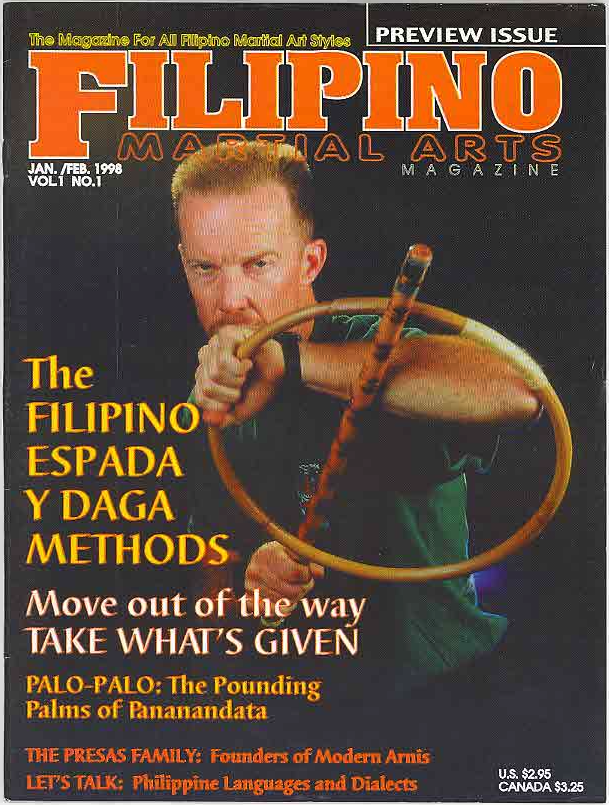
Third thought, I didn’t know FMA systems have trained with this unique weapon. The inaugural issue of Filipino Martial Arts Magazine’s, Jan/Feb 1998, Vol. 1 No. 1 cover portrays a FMA practitioner with stick and rattan ring in hand. In the article Filipino Espada y Daga Methods by James A Keating, the author wrote “The study of the sword and dagger arts are said to be the basis for all true two hand skills. Once acquired it is easily transferred over to other weapons and applications as shown in this shot of the stick and ring. These items are deployed in a manner similar to the actions of the Espada y Daga (sword and Dagger).”2
Pananandata, the Filipino martial art system of the Mariñas family, trained with various weapons including this rattan ring. In their book Pananandata: History and Techniques of the Daga, Yantok, Balisong, and Other Traditional Weapons of the Philippines, by Amante Mariñas Sr., the author wrote “When I was growing up, the dikin (ring) and the rice grinder were ever present in our kitchen. The dikins were used to hold round-bottomed clay pots to prevent them from toppling over and spilling their contents.”3 He said that his “village is the birthplace of his family’s fighting system.”4 and it supports a core tenet I’ve learned in my study of Filipino martial arts – learn to use everyday things to protect yourself.
Maybe the rattan ring weapon originated in the Philippines. Maybe it traveled from China to the Philippines. Regardless of how the dikin became part of the Filipino martial arts weaponry, it is a Filipino weapon and I need to do some research to learn how to use this everyday kitchen item as a defensive and offensive weapon. More to come.
- Rapid Journal: Research and Propagation for Internal Arts Development, July – September 1996, Vol 1 No. 1, p. Inside Cover ↩︎
- Filipino Espada y Daga Methods, James A Keating, Filipino Martial Arts Magazine, Jan/Feb 1998, Vol. 1 No. 1, p. 15. ↩︎
- Pananandata: History and Techniques of the Daga, Yantok, Balisong, and Other Traditional Weapons of the Philippines, Amante Mariñas Sr., Paladin Press, 2002, p. 2 ↩︎
- Pananandata: History and Techniques of the Daga, Yantok, Balisong, and Other Traditional Weapons of the Philippines, Amante Mariñas Sr., Paladin Press, 2002, p. 3 ↩︎
 FMA Chronicles
Leave a comment