Remy Presas described Arnis as “…a brutal sport and I’ll give you a story that might help explain. After the bombing of Pearl Harbour the Japanese occupied the entire South East [sic] of Asia within three weeks, but not the Philippines, it took them over three months to force us to surrender.”1
After World War II, Arnis experienced a significant decline in practitioners. “Like many Filipino cultural practices and products, arnis fell to the powerful influences from outside cultures. It became a displaced practice, was regarded as inferior or insignificant and was replaced by other martial arts – by a people who came to prefer foreign things to their own things. This is a major reason why many Filipinos never heard the word ‘arnis’ and practiced tae kwon do (sic) [a Korean martial art] and karate [a Japanese martial art] instead.”2 3
“More glamorous were the Japanese arts such as Karate and Chinese Kung Fu, with their crisp uniforms and organized classes. They also took less of a toll on those training. Learning the Filipino arts often meant taking repeated devastating strikes.”4
Filipinos had a general preference for imported brands over domestic products. Other factors like numerous dialects, regionalism and rivalries among different Arnis groups helped to further disperse Arnis and hindered its improvement.
The traditional concepts and training methods were often “insensible” and very rough; for example, instructors insisted that the stick (aka cane) was “sacred” and taught students to strike their partner’s hands and forearms rather than hitting their partner’s stick, which led to frequent injuries, loss of motivation, and students immediately losing interest. This harsh environment was compounded by the fact that few instructors had college education in physical education subjects like anatomy, biomechanics, or modern teaching methods.5 6
“After World War II, the Filipinos finally regained their independence from loathsome foreign rule. Many of the proven arnis fighters then migrated to the United States, mostly to California and Hawaii. Very few philanthropists remained in the Philippines to spread the art of arnis internally. Consequently, the art suffered an unfortunate decline for some time.”7
Remy “modernized [the art] and promoted hitting the cane instead for practice. Then I identified the basic concepts of the many Filipino systems I had learned to bring a unity to the diverse systems of my country. This way, we could all feel the connection.”8
“My purpose is to help everybody understand Arnis safely. I saw a real Arnis duel between two families when I was nine to ten years old and it broke my heart. Both these men were very good but became cripples, needing crutches. They were no longer useful and they couldn’t use their Arnis any more. It was a sin, just to prove who was better, but they were both losers. It really opened my eyes.”9
He traveled the country blending the most effective principles of various island styles, combining them with knowledge from other martial arts like karate, judo, and kenpo (spelled keno in source), creating Modern Arnis. He refined aspects of arts like tjakele, arnis de mano, jujutsu, and dumog, and unified the basic concepts of the diverse Filipino systems to create connection and consistency.10 11
“Arnis training differs from most traditional concepts of instruction. Basically, arnis deals with the simplicity of a person’s natural movement. Instead of reprograming a person’s natural movement to fit the art, arnis is adapted to fit the student’s natural movement…With arnis, the goal is to develop an individualized system of self-defense based on a person’s inherent physical characteristics.”12
Presas opened his first commercial Arnis school in his province of Negros Occidental in 1957. By giving demonstrations, such as at West Negros College, he convinced people that Arnis was a “renewed art”. He incorporated judo and karate techniques into Modern Arnis and used his involvement with these arts as a springboard to promote Filipino martial arts. Presas introduced Modern Arnis to the Buerau of Public and Private schools in Negros Occidental in 1961.13 14
“Because of my love and dream about a better future for Filipino martial arts nationally, I left what I built up in Negros Occidental – my school, my teaching positions, my house and my 47-acre farm where I grew sugar cane – and moved to Manila in 1967, without any assurance that I would have enough money to live on. Because of a demonstration I gave at the National College of Physical Education in Manila, Philip Monserrate, the President of the (PAAF), gave me the opportunity to teach modern arnis there.”15
Remy’s efforts gained the attention of President Ferdinand E. Marcos and Major General José Rancudo.16 Eventually, Modern Arnis became a required course in many colleges throughout the Philippines.17 To further its institutional growth, Presas helped found the National Amateur Karate Organization and the Modern Arnis Federation of the Philippines (MAFP),18 and in 1971, the Philippine Arnis Association (PAA) was formed by various practitioners to serve as a national organization promoting Arnis.19
Presas also authored Modern Arnis: Philippine Stick Fighting, which was published in 1974 after nearly 12 years of writing.20 In 1994, he published The Practical Art of Eskrima, 2nd edition.
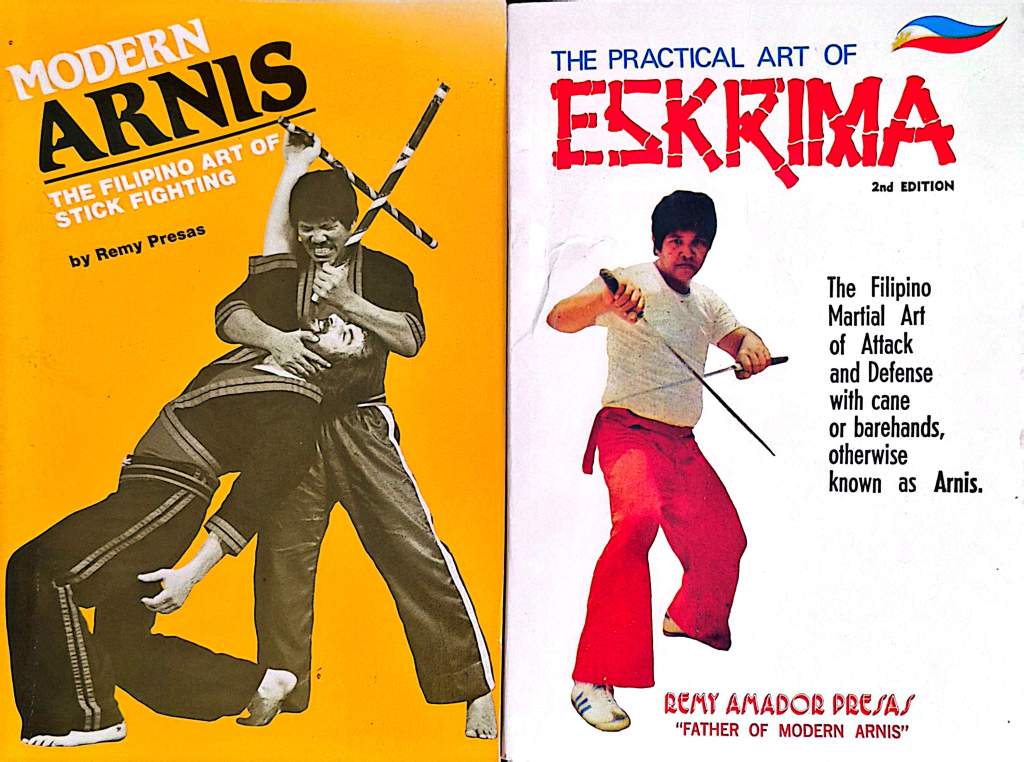
“If the Filipino martial arts were given recognition worldwide, then my dream would be realized.” – Remy Presas.21 22
Modern Arnis had successfully gained national acceptance and “steadily gained popularity”. Next – share the art globally.
Author Comment: I’ve studied Filipino Martial Arts for over ten years. I’ve told my 80+ year old mother, who has never tried a martial art class, repeatedly that I study Filipino Martial Arts. She repeatedly tells me that I’m studying karate.
- “Grandmaster Remy Presas: Arnis is the Art Within Your Art!. An Introduction to the ‘Father of Modern Arnis’”, Combat Magazine, October 2000. ↩︎
- “Remy Presas: Risking Life for his Art” by Rick Mitchell, Inside Kung-Fu Magazine, December 1990. ↩︎
- “Modern Arnis: The Filipino Art of Stickfighting” by Remy Presas, Ohara Publications, Inc., 1983 Digital Edition, 2014. ↩︎
- “Grandmaster Remy Amador Presas (1936-2001), by FMA Pulse, Jun 22, 2013. ↩︎
- “Remy Presas: Risking Life for his Art” by Rick Mitchell, Inside Kung-Fu Magazine, December 1990. ↩︎
- “Modern Arnis: The Filipino Art of Stickfighting” by Remy Presas, Ohara Publications, Inc., 1983 Digital Edition, 2014. ↩︎
- “Modern Arnis – Simply Effective” by John Hanson, Black Belt Magazine, September 1981. ↩︎
- “Remy Presas…Founder of Modern Arnis: Pioneer of the Philippine Arts is Still Polishing and Spreading his System”, by Jeffrey J. Delaney, Black Belt Magazine, August 1998. ↩︎
- “Grandmaster Remy Presas. Arnis is the Art Within Your Art!”, Combat Magazine, October 2000. ↩︎
- The “Modern Arnis: The Filipino Art of Stickfighting” by Remy Presas, Ohara Publications, Inc., 1983 Digital Edition, 2014. Spelled the word as “keno” but an earlier physical copy publication “Modern Arnis: The Filipino Art of Stick Fighting by Remy Presas, Ohara Publications, Inc., 1983; 2004 Black Belt Communications pg. 4 spelled the word as “kenpo”. ↩︎
- “Remy Presas…Founder of Modern Arnis: Pioneer of the Philippine Arts is Still Polishing and Spreading his System”, by Jeffrey J. Delaney, Black Belt Magazine, August 1998. ↩︎
- “Modern Arnis – Simply Effective” by John Hanson, Black Belt Magazine, September 1981. ↩︎
- “Remy Presas: Risking Life for his Art” by Rick Mitchell, Inside Kung-Fu Magazine, December 1990. ↩︎
- “Grandmaster Remy Presas: Arnis is the Art Within Your Art!. An Introduction to the ‘Father of Modern Arnis’”, Combat Magazine, October 200 ↩︎
- “Remy Presas: Risking Life for his Art” by Rick Mitchell, Inside Kung-Fu Magazine, December 1990. ↩︎
- “The 36 Hour Martial Art” by Richard Zimmerman, Black Belt Magazine, November 1977. ↩︎
- “Remy Presas: Risking Life for his Art” by Rick Mitchell, Inside Kung-Fu Magazine, December 1990. ↩︎
- “The 36 Hour Martial Art” by Richard Zimmerman, Black Belt Magazine, November 1977. ↩︎
- “Remy Presas: Risking Life for his Art” by Rick Mitchell, Inside Kung-Fu Magazine, December 1990. ↩︎
- “Remy Presas: Risking Life for his Art” by Rick Mitchell, Inside Kung-Fu Magazine, December 1990. ↩︎
- Presas Takes his Modern Arnis to the World, Rick Mitchell, Inside Kung-Fu Magazine, January 1991. ↩︎
Revisions:
- December 7, 2025 – Replace picture of Remy’s books.
 FMA Chronicles
Leave a comment